Introduction: Spirits, Power, and Performance
In the stylised, high-energy world of Kpop Demon Hunters, K-pop idols transform into fierce demon hunters beneath glowing city lights. With glittering eyes and choreographed precision, they strike down spiritual threats in a world where tradition and spectacle collide. At first glance, this universe feels sleek, modern, and unapologetically pop. But look a little closer, and something older begins to stir beneath the neon.
That something is Korean shamanism.
Though never named directly, the presence of the mudang (무당), the Korean shaman, lingers at the edges of this world. Mudang are spirit mediums, traditionally women, who serve as intermediaries between the living and the dead. These figures have long played a central role in Korea’s spiritual life, though they have often existed at its margins.
In Kpop Demon Hunters, we see echoes of this tradition through the talisman-like visuals, the performative nature of spiritual battle, and the strong female figures who channel unseen forces through movement and intuition. This post examines how Korean shamanism and the archetype of the mudang subtly influence the aesthetic, spirit, and symbolism of Kpop Demon Hunters, demonstrating that even in the realm of fantasy, the sacred still finds a stage.
If you are interested in the folkloristic meanings of Derpy and Sussie, read more on this page.
Korean Shamanism in the Design of Kpop Demon Hunters
While Kpop Demon Hunters is not a literal retelling of Korean religious history, the influence of Korean shamanism is present in symbolic and stylistic forms. From the way energy is depicted to how the characters engage with spirits and the supernatural, the film weaves spiritual elements into its storytelling. These influences do not always come from the surface of folklore, but from deeper visual and mythological patterns that have long existed in Korean culture. Here, we explore those connections through the lenses of movement, design, weaponry, and roles.
Spiritual Energy as Performance
In traditional shamanic rituals, the mudang uses her body as a medium. Movement, breath, and rhythm are not simply tools of expression. They are how the invisible is made visible. A flick of the wrist, a spin, a chant — each gesture draws or pushes the spiritual into the material world and the spirit world.
In Kpop Demon Hunters, battle scenes function much like these rituals. Characters do not just fight, they move, with choreography that blends martial precision with theatrical flair. This is especially significant in a story that centres on K-pop idols. In Korean shamanism, performance is sacred, and in this universe, the act of performance becomes a weapon against darkness.
The idea that rhythm, repetition, and emotional intensity can alter reality is a fundamental belief shared by both K-pop performance and shamanic ritual. It suggests that power doesn’t come only from force, but from resonance. From creating harmony between body, sound, and spirit.
The Balance of Yin and Yang
In Korean philosophy, the world is shaped by the interaction of yin and yang, two complementary forces. Yin represents darkness, stillness, and the unseen, often associated with spirits and the dead. Yang represents brightness, energy, movement, and life. For balance to exist, these two forces must remain in a shifting harmony.
In Kpop Demon Hunters, this dynamic plays out symbolically in the moment when Honmoon closes during Huntrix’s performance. Though not explicitly explained in the story, one interpretation is that Huntrix’s performance is filled with powerful yang energy, heat, music, light, and human excitement. It is not chaos that causes the gate to close, but the overwhelming presence of life force. The stage, saturated with movement and vitality, becomes a space where yin can no longer linger.
The spirits, being of yin nature, do not disappear. They wait. They retreat. Because in this moment, yang fills the space entirely, leaving no room for the subtle currents of the other world.
This quiet moment of closure reflects a deeper truth from Korean spiritual thought: even in a story built on fantasy and pop culture, the ancient laws of balance still hold.
Ritual Choreography and the Idol–Mudang Parallel

In Korea, there is a saying: “아이돌과 무당의 사주는 종이 한 장 차이이다.” It means that the fate or energy of a mudang and a K-pop idol are almost identical, separated only by a thin sheet of paper. Though said half in jest, the saying captures a real cultural sentiment. Both are performers, channelers, and emotional vessels for something greater than themselves.
The mudang enters trance, dances with ancestral spirits, and delivers messages through breathless chants and trembling limbs. Her body becomes a stage where invisible forces are at work. In a different context, the K-pop idol trains for years to master performance, not just for technical precision, but to stir emotion, to move the audience through energy. The body becomes a language, a ritual space. It is no wonder that both roles are said to require someone who is born with the saju (사주), or spiritual constitution, to handle the strain of channelling that much feeling.
In Korean shamanism, rhythm is everything. The beat of the janggu (장구) drum, the repeated steps of a dance, and the swelling chant, all these elements help lift the shaman into a state of trance. In this state, the mudang is no longer herself. She becomes a vessel for gods, ghosts, or ancestors, delivering messages and healing through performance.
In Kpop Demon Hunters, the battles resemble performances. Characters do not fight in straight lines. They spin, gesture, and strike in synchrony, often surrounded by stylised lights or sound waves. These aren’t just artistic choices. They echo the ritual choreography of the gut. Even in idol culture, fans often describe their favourite performers as “possessed on stage” or “becoming someone else when the music starts.” This language mirrors how people describe the mudang during trance.
Both the idol and the mudang sacrifice their body to the gaze of others. Both become conduits. One channels spirit. The other channels sound. But both leave behind the self to embody something more.
In that sense, Kpop Demon Hunters doesn’t just create flashy action scenes. It recreates the spiritual logic of Korean shamanism, where movement is not just expression—it is transformation.
Weapons as Spiritual Tools

In traditional Korean shamanism, weapons are not for combat in the physical sense. They are spiritual tools. A mudang might use bells to summon attention, a mirror to reflect negative energy, a fan to guide spirits, and a ceremonial knife to sever misfortune. These objects are not meant to wound, but to protect, guide, and cleanse.
Kpop Demon Hunters transforms these ritual instruments into elegant, stylised weapons, imbued with supernatural energy but grounded in cultural meaning.
Rumi’s sword, the Sain-geom (사인검), translates to “Four Tigers Evil Slayer.” This is not a fantasy name invented for flair. The sain-geom is a real ceremonial sword used in traditional Korean rituals, often engraved with mystical tiger imagery and Taoist or shamanic inscriptions. Its purpose was to ward off malevolent spirits and purify sacred spaces. That Rumi wields this blade as her main weapon directly links her to the role of a protector and exorcist, echoing the role of the mudang during a gut.
Mira’s weapon, the Gok-do (곡도), is a curved, moon-shaped sword. Crescent blades have symbolic resonance across East Asian traditions, but in this case, the moon curve evokes feminine energy, intuition, and cyclical power—qualities often associated with female shamans. The Gok-do’s elegant arc and luminous motion in battle call to mind the grace and danger of ritual movement, where beauty and threat coexist.
Zoey’s dual weapons, the Shin-kal (신칼), are called “spirit blades.” These, too, are rooted in actual shamanic tradition. Shin-kal, or “god blades,” are used by shamans during rituals to ward off evil, sever spiritual attachments, or symbolically battle unseen forces. They are often held during trance states or while channelling deities. In Kpop Demon Hunters, Zoey’s use of spirit blades is not just a combat style, but a direct invocation of shamanic power and spiritual agency.
Each weapon is more than a tool for action. It is a spiritual extension of the character’s role in the story. They reflect Korean beliefs about the unseen world, the importance of ritual, and the idea that the fight against darkness is not physical, but symbolic and sacred.
Honmoon: A Fictional Gate with Real Symbolism
In Kpop Demon Hunters, Honmoon (혼문) is the name of the mystical gate that separates the human world from the spirit realm. Although the term does not exist in traditional Korean shamanism, it carries symbolic meaning drawn from familiar Korean roots. The word “혼” (hon) means “soul” or “spirit,” and “문” (mun) means “gate” or “door.” Together, Honmoon can be interpreted as “gate of souls” or “spirit gate.”
This naming is not accidental. In Korean shamanism, the mudang is known for opening ritual spaces where spirits can cross between realms. Honmoon reflects that same threshold logic—a border between life and death, the visible and invisible. Though newly invented, the word feels old, rooted in the spiritual architecture of Korean belief.
In the story, Honmoon serves as more than a plot device. It is a visual and narrative symbol of spiritual transition, and its closing or activation ties directly into the film’s central conflict. While not grounded in religious ritual, it carries the same cosmic weight that shamanic thresholds once did in village ceremonies and funerary rites.
Saja Boys and the Reapers of Folklore
The Saja Boys are a supernatural squad that appears in the world of Kpop Demon Hunters. The word 사자 (saja) in Korean often means “lion,” which is why the group’s logo features a lion. It can also mean literally ‘dead person’. However, in a folkloric and spiritual context, it refers to the grim reaper, or more specifically, the 저승사자 (jeoseung saja). These figures are spirit messengers who escort souls to the afterlife. In paintings and stories, they are often depicted wearing black robes and carrying a scroll with the name of the deceased.
The reaper in Korean folklore is not always cruel. Sometimes, the saja appears confused, lazy, or even sympathetic, depending on the story. But no matter the mood, they are always a boundary walker, a figure who exists between this life and the next.
In Kpop Demon Hunters, the Saja Boys represent this liminal role. Their name connects them directly to the underworld, even if the visual design is updated with stylised uniforms and charm-infused accessories. Like the mudang, they are not ordinary characters. They belong to the world behind the veil.
The Mudang Archetype: Ritual, Gender, and Subversion
At the heart of Korean shamanism is the mudang (무당), a spiritual practitioner who serves as a bridge between the human and spirit worlds. Unlike the image of a sage meditating in silence, the mudang performs her work through movement, music, and ritual. Her power is not hidden in texts, but carried through performance, often in the form of a gut (굿), a ceremonial rite that involves dance, song, offerings, and at times, possession by ancestral or natural spirits.
Traditionally, mudang are women, often those who have experienced a spiritual illness known as 신병 (sin byeong). This is not seen as madness, but as a sign of spiritual calling. Through initiation, the individual becomes a vessel for divine communication, someone who can mediate between the world of the living and the unseen.
In historical Korea, the mudang stood in a complex social space. She was respected as a healer, protector, and voice for the forgotten. Yet she was also marginalised, seen as both necessary and taboo. Her ritual space was sacred, but never quite accepted by official religions or ruling elites.
The visual world of the mudang is vibrant and rich in symbolism. She wears layered garments, often with bright colours and traditional accessories like bells, fans, knives, and mirrors. These are not decorative items, but spiritual tools designed to ward off harmful spirits, attract beneficial ones, and reveal hidden truths. Her dance is not just art, but a form of prayer. Her chants are not songs, but calls across the veil.
Understanding the role of the mudang allows us to better recognise the deep roots of Korean shamanism. It is not a dead tradition, nor one locked in the past. It continues to evolve, emerging in new forms, voices, and, yes, even new animations.
A Woman Between Worlds
Traditionally, most mudang are women, and that alone is significant. In a deeply Confucian society, where male authority ruled the public and private spheres, the mudang held a kind of unofficial spiritual authority. She did not speak with the voice of government or scripture, but she spoke with the voice of ancestors, of forgotten gods, of the people. She spoke from somewhere else, and that voice was impossible to silence.
But why is a mudang almost always a woman? One key reason is the experience of 신병 (sinbyeong), or “spirit sickness.” It is a mysterious, often debilitating condition where the chosen individual suffers from unexplained illness, visions, or emotional turmoil. In traditional belief, this signals a calling from the spirit world. Women, who were culturally viewed as more emotionally expressive and spiritually sensitive, were more often recognised as having this kind of connection.
Confucian society gave women few formal roles in religion, education, or politics. But shamanism lived outside of those systems. The mudang held spiritual authority without needing permission from elite structures. She could speak to ancestors, heal the sick, and interpret omens. In doing so, she claimed a kind of power that was otherwise denied.
Ritual performance also played a part. A gut involves movement, singing, tears, and trance. These expressions, often stigmatised in public, were central to the mudang’s practice. In rural and spiritual contexts, women were considered more suited to embodying spirits, crossing into altered states, and navigating the emotional intensity of ritual.
Finally, there’s the symbolic layer. In East Asian cosmology, yin (associated with the feminine) is linked to the unseen world, intuition, and night. The mudang, as a liminal figure who moves between the living and the dead, fits this energy.
In Kpop Demon Hunters, the main characters are women. They are not assistants or sidekicks. They are protectors. Their power is not inherited from a patriarchal figure, but activated through experience, emotion, and ritualised performance. This mirrors the mudang’s journey, where spiritual authority comes not from title, but from being chosen by spirits, by fate, or by suffering.
Why Shamanic Symbols Matter in Modern K-Culture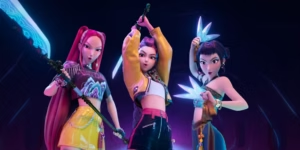
Korean shamanism is one of the oldest living spiritual traditions on the peninsula. It has survived dynastic suppression, Confucian disapproval, colonial erasure, and modernisation. Yet, today, it is still practised in rituals across Korea, and is also being reimagined in media, art, and performance. In this resurgence, Kpop Demon Hunters plays a small but meaningful role.
Modern Korean culture is saturated with visual and spiritual references to its shamanic roots, whether consciously or not, from talismanic symbols printed on drama costumes, to musical elements drawn from ritual chants, to characters that echo spirit mediums or grim reapers. The language of the mudang is still spoken, even if the voice has changed.
Shamanism, Not Superstition
For many years, Korean shamanism was seen as backwards or superstitious. During rapid modernisation, especially in the twentieth century, the role of the mudang was often mocked or pushed to the cultural margins. The drums of the gut were silenced in favour of steel and neon.
But in recent decades, there has been a quiet reclaiming. Artists, filmmakers, and performers have begun to draw from shamanic aesthetics with respect, curiosity, and power. Rather than erasing the past, they are remixing it. Korean shamanism is no longer something hidden. It is being reinterpreted in webtoons, K-dramas, stage performances, and even idol concepts.
Fantasy as Cultural Memory
Kpop Demon Hunters does not advertise itself as a spiritual narrative. It is action-packed, stylish, and filled with pop fantasy. However, through its use of weapons, choreography, character dynamics, and symbolic names, it channels elements of Korean shamanism. The film becomes a place where the sacred and the pop coexist, not through direct storytelling, but through cultural memory.
By giving characters spirit-linked weapons, creating Honmoon, or drawing on visual languages of possession, performance, and transformation, Kpop Demon Hunters continues the work of tradition, but through a modern aesthetic lens.
This is not simply nostalgia. It is a form of cultural continuity. In an era when Korea exports media worldwide, these symbols carry more than just entertainment value. They carry meaning. And even when audiences don’t recognise them consciously, they are still part of what makes the world feel uniquely Korean.


